Pseudo-states commands#
Let’s talk about the pseudo-states:
\umlstateinitial[name=initial]
\umlstatefinal[x=1, name=final]
\umlstatejoin[x=2, name=join]
\umlstatedecision[x=3, name=decision]
\umlstateenter[y=-2, name=enter]
\umlstateexit[x=1, y=-2, name=exit]
\umlstateend[x=2, y=-2, name=end]
\umlstatehistory[x=3, y=-2, name=hist]
\umlstatedeephistory[x=4, y=-2, name=deephist]
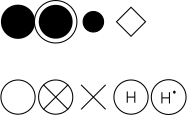
From left to right and top to bottom:
An initial state is defined with the
\umlstateinitialcommand;A final state is defined with the
\umlstatefinalcommand;A join state is defined with the
\umlstatejoincommand;A decision state is defined with the
\umlstatedecisioncommand;An enter state is defined with the
\umlstateentercommand;An exit state is defined with the
\umlstateexitcommand;An end state is defined with the
\umlstateendcommand;A history state is defined with the
\umlstatehistorycommand;A deep history state is defined with the
\umlstatedeephistorycommand.
These commands take several options: name, to rename the node, and width to set their size.