State-transitions diagrams#
State-transition diagrams are used to represent the behavior of a system, by showing the states of the system and the transitions between these states. In this chapter, you will see how to define states and transitions in a state-transition diagram.
In such diagrams, you will find:
states: see Environment umlstate for more details
pseudo-states: see Pseudo-states commands for more details
transitions: see Definition of relationships for more details
notes: see Command \umlnote for more details
Sub-states#
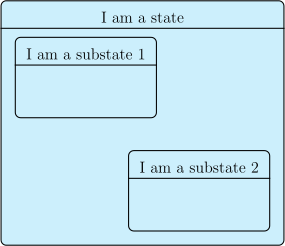
You can define a state in another state. Then, the coordinates of the sub-states are relative to the parent state:
\begin{umlstate}[name=state]{I am a state}
\begin{umlstate}[name=substate1]{I am a substate 1}

\end{umlstate}
\begin{umlstate}[x=3, y=-3, name=substate2]{I am a substate 2}

\end{umlstate}
\end{umlstate}